
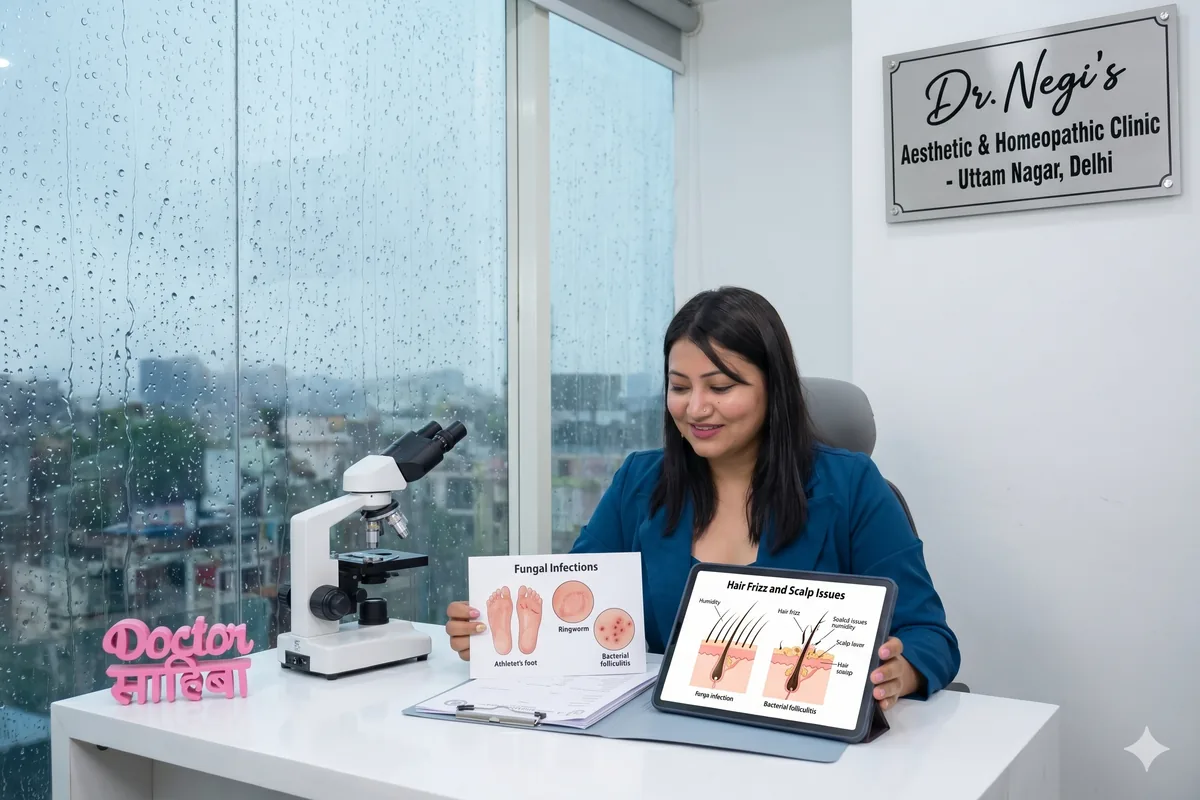

Every year around July, my appointment book fills with the same problems: fungal rashes, sudden acne flares, heat rash that won't clear, eczema that was quiet for months and is back. Delhi monsoon does this. The humidity sits at 85–95%, temperatures hold in the 30–35°C range, and the air carries more particulate matter than summer because rain traps pollutants close to the ground. Your skin gets caught in all of it.
Most skin care advice is written for European climates. A British dermatologist saying "use a light moisturiser in summer" is not thinking about 90% humidity in Uttam Nagar in August. Our conditions are specific. What follows is what I actually tell patients during this season.
Why Monsoon Is Harder Than Summer on Your Skin
Summer in Delhi is hot but dry. Your skin's acid mantle (the slightly acidic protective film) stays relatively intact because sweat evaporates quickly.
Monsoon changes that equation. Sweat doesn't evaporate. It sits on the skin surface for hours, creating a warm, moist environment that fungi grow in. The same humidity that keeps your throat from getting parched is actively inviting tinea and candida to set up on your skin.
Sebum production also increases with heat. People who have no acne problems in November start breaking out in July. Pores clog not just with dead skin but with sweat and pollution particles that stick to oily skin. Early monsoon air quality is deceptive, too. Rain picks up particulate matter, nitrogen dioxide, and ozone from the atmosphere and deposits it back onto whatever is exposed, including your face.
Three things hitting at once: fungal risk, increased oiliness, and pollution deposition. That's why patients who managed fine through summer walk in looking rough in July.
The Most Common Problems I See July–September
Fungal infections are the most common. They spread in humid skin folds and footwear that doesn't dry properly. The classic presentation is a ring-shaped or irregular red rash with a raised border — intensely itchy, spreading outward. Candida shows up as a deeper red rash with satellite lesions (small separate spots around the main patch). Both need antifungal treatment; they don't resolve on their own in monsoon humidity.
Acne flares affect patients who had their skin under control during drier months. The humidity and sweat overwhelm skin that was otherwise balanced. In my experience, patients who had been doing well from October through May often see a July setback even without any change in their routine.
Prickly heat develops when sweat glands get blocked. Unlike fungal rash, it presents as tiny red or clear bumps over a large area (chest, back, neck) and burns rather than itches. It's uncomfortable and can become infected if scratched.
Eczema and psoriasis flares hit patients with these conditions reliably. The heat triggers inflammatory responses, and sweat irritates skin that's already sensitive.
What to Stop Doing
Heavy oil-based moisturisers. If your moisturiser leaves a greasy film after 20 minutes, swap it out until October. Thick creams trap sweat and create the humid microenvironment that fungi need. A lightweight gel or water-based lotion is enough when ambient humidity is already doing the heavy lifting.
Skipping SPF because it's cloudy. Clouds block visible light, not UV radiation. On an overcast Delhi day, UVA levels drop only about 20–30%. UV accumulates. Mineral SPF 30–50 (zinc oxide or titanium dioxide) is your best option during monsoon. It's less pore-clogging than chemical filters and provides a minor physical barrier against pollution deposition.
Over-washing. Washing your face four times a day strips the acid mantle and leaves skin more vulnerable to infection. Twice a day is enough. Use a gentle pH-balanced cleanser, around pH 4.5–5.5. If your face feels "squeaky clean" after washing, the cleanser is too alkaline and is damaging your barrier.
A Routine That Makes Sense for Delhi Monsoon
Morning: Gel cleanser → niacinamide serum (controls oil, reduces inflammation, no irritation) → lightweight non-comedogenic moisturiser → mineral SPF 50. For oily, breakout-prone skin, a 2% salicylic acid product in the morning instead of niacinamide works well.
Evening: Oil cleanser first to dissolve SPF and pollution (this step matters in Delhi; skipping it means pollution particles stay on your skin overnight) → gel cleanser → either retinol, salicylic acid, or niacinamide. Not all three. Pick one active, use it consistently.
Body: Shower immediately after getting home, especially after metro travel. Pat completely dry, every skin fold. If you're prone to fungal infections, an antifungal dusting powder (clotrimazole or miconazole) on the groin, underarms, and between toes every morning makes a significant difference. Cotton clothing only.
When Homeopathy Changes the Pattern
Some patients get the same skin problems every monsoon, year after year. Fungal infection every July. Eczema every August. Monsoon acne every season regardless of their routine.
When this happens repeatedly, it tells us something about constitution: your individual susceptibility to specific triggers. Constitutional homeopathy addresses that susceptibility rather than just treating the current outbreak.
For recurring tinea, remedies like Tellurium, Sepia, and Graphites work on the underlying tendency, not just the rash. Most patients on a correctly matched remedy see meaningful reduction in frequency and severity after one full monsoon season on treatment.
Sulphur works for people who are generally worse in heat and humidity: oilier skin, more itching, redness that keeps coming back. Graphites suits thickened skin in folds that develops weepy or sticky eruptions. Hepar Sulph fits when skin becomes infected easily, even from minor cuts or insect bites.
For monsoon acne flares in patients already on treatment with us, we often just need to adjust potency or dosing frequency. The trigger has changed (humidity, sweat), but the underlying prescription is usually still appropriate.
When to Come In
A mild fungal rash or a few extra pimples can usually be managed at home. Come to the clinic if:
- A rash is spreading despite OTC antifungal cream after 5–7 days
- Any lesion is painful, warm, or swollen (this suggests bacterial infection on top of fungal)
- Acne is cystic (deep, hard, under the skin). Cysts don't respond to topical creams and can scar badly if untreated
- Heat rash is spreading to the face
- You've had the same skin problem return in 2+ consecutive monsoon seasons
For patients already on treatment with us: WhatsApp before coming in. In many cases we can adjust your protocol remotely.
What's Realistic
Perfect skin during Delhi monsoon is not a realistic goal for everyone. If you have naturally oily skin, you will be oilier. If you have eczema, you may flare. The goal is to reduce severity, not to pretend the season doesn't exist.
What is realistic: keeping fungal infections from taking hold, preventing acne from going cystic, and protecting your skin barrier so you're not back to square one in October.
If you'd like to discuss your specific skin concerns during monsoon, book a consultation here or WhatsApp us at +91 99530 77426. Monday–Saturday 10 AM–7 PM, Sunday 10 AM–2 PM.
Written by Dr. Preity Negi, BHMS, PGD (Facial Aesthetics & Clinical Cosmetology), practicing in Uttam Nagar, West Delhi since 2011.
Medical disclaimer: This article is for informational purposes only and does not constitute medical advice. Consult a qualified healthcare professional for diagnosis and treatment of skin conditions.