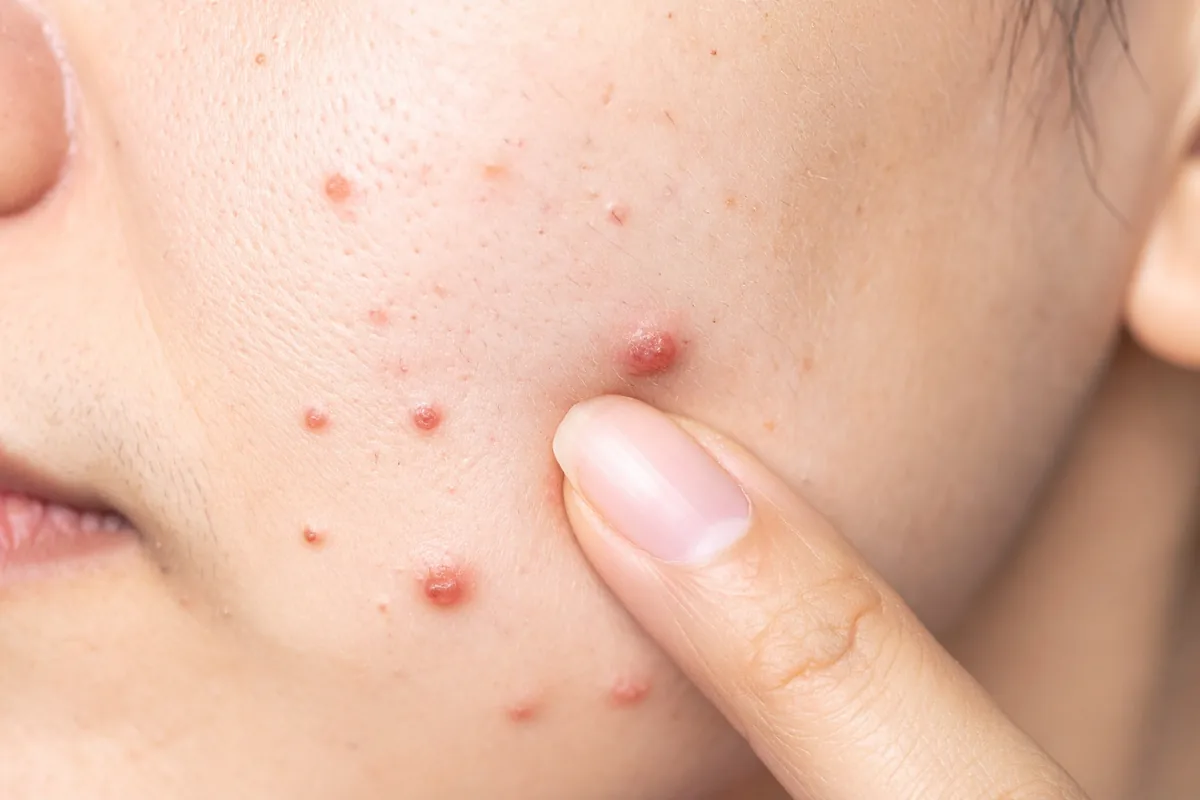

Hormonal acne appears on the jawline, chin, and lower face because androgen receptors are concentrated in these areas — and no amount of face wash or retinol cream can fix an internal hormone imbalance. At Dr. Negi Clinic, we treat the root cause with constitutional homeopathy while managing active breakouts with aesthetic treatments. This combination resolves hormonal acne in 80% of patients within 4–6 months.
If you're a woman in your 20s or 30s watching deep, painful cysts appear along your jawline before every period, and you've already tried multiple creams, cleansers, and even antibiotics without lasting results — you're treating a hormonal problem with topical solutions. That mismatch is why nothing has worked.
How to know if your acne is hormonal
Not all adult acne is hormonal, but certain patterns are unmistakable indicators of an internal hormonal driver:
| Sign | What It Means | Why Creams Can't Fix It |
|---|---|---|
| Breakouts on jawline and chin | Androgen-driven oil production in these receptor-dense zones | Topicals can't reach androgen receptors under the skin |
| Flare-ups before periods | Progesterone drops 7-10 days pre-period, triggering sebum surge | The hormonal cycle isn't affected by what you apply externally |
| Deep, painful cysts under skin | Internal inflammation, not surface bacterial infection | Cysts form deep in the dermis, below where topicals penetrate |
| Started in your 20s–30s (not teens) | Hormonal shift, often linked to PCOS, stress, or thyroid changes | Age-related hormonal changes need systemic treatment |
| Doesn't respond to topical treatments | Because the cause is internal, not on the skin surface | This is actually the diagnostic clue — failure of topicals confirms hormonal origin |
If you match 3 or more of these patterns, hormonal imbalance is almost certainly the primary driver of your acne. Dr. Negi can confirm this with a targeted blood test panel.
The 5 root causes of hormonal acne
Each cause requires a different homeopathic approach:
1. PCOS (Polycystic Ovarian Syndrome) — This is the single most common cause of hormonal acne in Indian women. PCOS affects approximately 1 in 5 women in India, and excess androgen production is its hallmark. The elevated testosterone and DHEAS directly stimulate oil glands, producing the characteristic deep cystic acne along the jawline and lower face. Often accompanied by irregular periods, weight gain, and unwanted facial hair (hirsutism). A hormonal panel (LH, FSH, testosterone, DHEAS, AMH) plus ultrasound can confirm the diagnosis.
2. Estrogen dominance — This occurs when the estrogen-to-progesterone ratio becomes imbalanced, commonly after age 28. Modern lifestyle factors — xenoestrogens from plastics, processed food, sedentary habits — contribute significantly. Estrogen dominance causes a specific type of acne: smaller but persistent breakouts, often with water retention, breast tenderness, and PMS. It's subtler than PCOS acne but equally resistant to topical treatment.
3. Insulin resistance — Many patients don't realise that blood sugar directly affects skin. When cells become resistant to insulin, the pancreas produces more insulin to compensate. Elevated insulin increases the production of insulin-like growth factor 1 (IGF-1), which directly stimulates androgen production and sebum secretion. This is why dietary changes — particularly reducing refined carbohydrates and sugar — can significantly improve hormonal acne. It's also why metformin sometimes improves acne in PCOS patients, though it doesn't address the root cause.
4. Cortisol (chronic stress) — The adrenal glands produce cortisol in response to stress, and cortisol has a cascading effect on nearly every other hormone in the body. Chronic stress elevates androgens, disrupts estrogen-progesterone balance, increases insulin resistance, and weakens the skin barrier — essentially amplifying every other hormonal acne trigger simultaneously. Delhi's high-pressure work culture, pollution anxiety, and long commutes create a chronic cortisol environment that many patients underestimate.
5. Thyroid dysfunction — Both hyperthyroid and hypothyroid states affect skin health, though through different mechanisms. Hypothyroidism slows skin cell turnover, leading to congested pores and sluggish healing. Hyperthyroidism increases oil production and can cause inflammatory breakouts. Thyroid conditions are surprisingly common in Delhi NCR women (estimated 1 in 8) and are frequently undiagnosed. Dr. Negi routinely screens for thyroid function as part of the hormonal acne workup.
Why conventional treatments fail
If the cause is internal, external treatment will always be temporary.
Oral contraceptives are the most commonly prescribed conventional treatment for hormonal acne. They work by suppressing your body's natural hormone production and replacing it with synthetic hormones. While this can clear acne impressively, it's essentially putting a hormonal "band-aid" over the problem. When you stop the pill, the original hormonal imbalance is still there — often worse than before because your body's natural regulatory systems have been suppressed. Acne typically returns within 3-6 months of discontinuation, sometimes more severely than before.
Antibiotics (doxycycline, minocycline) kill acne-causing bacteria, but hormonal acne isn't primarily a bacterial problem — it's an oil production problem. Worse, long-term antibiotics disrupt gut bacteria, which actually worsens hormonal balance. The gut microbiome plays a crucial role in estrogen metabolism, and antibiotic-induced dysbiosis can increase circulating estrogen levels, compounding the original problem.
Isotretinoin (Accutane) dramatically shrinks oil glands, but has a 25% relapse rate in hormonal acne patients (compared to 10% for non-hormonal acne) because it doesn't address the hormonal driver. The side effects — severe dryness, liver stress, mandatory pregnancy prevention, depression risk — make it a poor risk-benefit choice when the underlying cause isn't being treated.
How homeopathy treats hormonal acne
Homeopathy works by restoring your body's natural hormonal equilibrium. Rather than suppressing or replacing hormones, it stimulates your endocrine system to self-regulate. This is why homeopathic results are lasting — the correction is internal and self-sustaining.
Pulsatilla — The premier remedy for acne worsening before periods, particularly in women with irregular menstrual cycles. The Pulsatilla patient is typically emotionally sensitive, tends toward tearfulness, feels better in open fresh air, and has changeable symptoms — acne that shifts location, periods that vary in intensity. This remedy works by gently regulating the progesterone-estrogen cycling that drives menstrual acne flares. Many patients notice their periods becoming more regular within 2-3 months of Pulsatilla use, with corresponding improvement in skin.
Sepia — The most important remedy for PCOS-related acne and hormonal exhaustion. The Sepia patient feels drained, irritable, and disconnected — often described as "bearing down" sensation both physically and emotionally. Accompanied by hair loss or thinning, low libido, fatigue, and brownish-yellowish skin discolouration. Sepia is one of the most deeply-acting hormonal remedies in homeopathy, capable of addressing the multi-system dysfunction of PCOS rather than just isolated symptoms.
Natrum Muriaticum — For acne with a specific skin pattern: oily skin on the forehead and nose (T-zone) but dry skin elsewhere, especially around the hairline and chin. Often triggered by emotional stress or suppressed grief. The Natrum Mur patient tends to be reserved, doesn't cry easily in front of others, and holds onto emotional pain. This remedy addresses the cortisol-hormone connection, resolving stress-driven hormonal disruption.
Calcarea Carbonica — For overweight patients with acne, heavy prolonged periods, cold sensitivity, and a tendency toward sluggish metabolism. This constitutional remedy addresses the insulin resistance pathway of hormonal acne. Patients who need Calcarea Carb often have a sweet tooth, sweat easily (especially on the scalp), and tire easily with exertion. The metabolic correction from Calcarea Carb often results in gradual weight normalisation alongside skin clearing.
Folliculinum — A lesser-known but powerful remedy specifically for estrogen dominance-related acne. Made from synthetic estrogen, it works on the principle of "like cures like" — the body's response to the remedy is to correct estrogen excess. Particularly useful when acne worsens mid-cycle (around ovulation) or when accompanied by severe PMS, breast tenderness, and water retention.
Treatment typically takes 3–6 months. 80% of our patients see significant improvement by month 4, and many are able to discontinue all previous acne medications.
Combining homeopathy with aesthetic treatments
While homeopathy corrects the internal imbalance — which takes weeks to months — aesthetic treatments provide visible improvement in the meantime:
Salicylic peels (₹2,000–₹3,000) — A beta-hydroxy acid that penetrates through oil to unclog pores. Particularly effective for the comedonal component of hormonal acne (blackheads, whiteheads alongside cysts). A course of 4-6 peels at 2-3 week intervals delivers cumulative improvement.
HydraFacial (₹2,500–₹4,000) — Gentle, non-irritating deep cleansing and hydration infusion. Unlike harsh extractions that can worsen hormonal cysts, HydraFacial uses vortex technology to clean pores without trauma. Monthly sessions maintain skin clarity while homeopathy addresses the root cause.
LED Blue Light (₹1,000–₹2,000 per session) — Targets P. acnes bacteria with 415nm wavelength light, reducing the inflammatory component of hormonal acne. Non-invasive, painless, and no downtime. 8-10 sessions over 4-5 weeks for optimal bacterial reduction.
Real patient results
"I tried everything for 6 years — three different dermatologists, two courses of Accutane, and expensive creams that my bathroom drawer overflows with. My jawline acne kept coming back within weeks of stopping any treatment. Dr. Negi diagnosed PCOS through blood tests that no dermatologist had ever ordered, and started Sepia 200. After 4 months, my skin is clearer than it's been since I was 18. My periods are regular for the first time in years. I wish I'd found this clinic 6 years ago." — Saumya R., Age 29, Vikaspuri
"Post-pregnancy, my face erupted with deep, painful cystic acne — something I'd never experienced before. My OB-GYN said it was hormonal and would resolve on its own. After 8 months of waiting, it was only getting worse. Dr. Negi prescribed Pulsatilla along with monthly HydraFacials. The cysts started shrinking within 3 weeks. By month 3, my skin was clear." — Kavita D., Age 32, Janakpuri
Frequently asked questions
Can I treat hormonal acne without birth control pills?
Absolutely. Homeopathy is specifically designed to restore hormonal balance naturally without synthetic hormones. Many of our patients come to us specifically because they want to stop relying on oral contraceptives for skin management. Dr. Negi's approach addresses the actual hormonal imbalance, so the improvement is lasting even after you stop the remedy — unlike birth control, where acne returns after stopping.
How do I know if my acne is related to PCOS?
Key indicators include: jawline acne, irregular periods, weight gain (especially around the abdomen), excess facial/body hair, and difficulty losing weight. A blood test panel (LH, FSH, testosterone, DHEAS, insulin, AMH) and a pelvic ultrasound can confirm PCOS. Dr. Negi includes this screening as part of your initial evaluation when hormonal acne is suspected.
Will dietary changes help my hormonal acne?
Diet plays a significant supporting role, particularly if insulin resistance is a factor. Reducing refined sugar, processed carbohydrates, and dairy (which contains bovine hormones that can worsen human hormonal acne) often improves results. Dr. Negi provides personalised dietary guidance as part of the treatment plan. However, diet alone rarely resolves hormonal acne — it needs to be combined with proper hormonal treatment.
I'm in my late 30s and just started getting acne. Is this perimenopause?
It's possible. Perimenopausal hormonal fluctuations can trigger acne in women who never had skin problems before. As estrogen declines and the estrogen-to-androgen ratio shifts, androgen-driven acne can appear for the first time. This is actually one of the most responsive forms of hormonal acne to homeopathic treatment because the body is already in a state of hormonal transition, making it amenable to gentle rebalancing.
Related reading
- Acne Treatment: Homeopathy + Aesthetic Dual Approach
- PCOS Treatment: How Homeopathy Balances Hormones
- Homeopathic Acne Scar Treatment Guide
- Hair Loss Treatment: Homeopathy + PRP
Explore our services
- Skin & Hair Conditions — Homeopathy — Root-cause hormonal treatment for persistent acne
- Acne Scar Treatment — Aesthetic procedures for post-acne marks and scarring
- Women's Wellness & PCOS — Addressing PCOS-driven hormonal acne at the source
- View all services →
Book your hormonal acne assessment
📞 Call: +91 99530 77426 💬 WhatsApp: Message Dr. Negi 📍 Clinic: Metro Pillar 664, Uttam Nagar, New Delhi 🕐 Hours: Mon–Sat 10 AM–7 PM, Sunday 10 AM–2 PM
Disclaimer: Hormonal acne requires proper diagnosis. Blood tests for hormones and PCOS screening may be recommended. Individual results vary. This content is for educational purposes only.
References:
- Bhate K, Williams HC. (2013). Epidemiology of acne vulgaris. British Journal of Dermatology, 168(3), 474-485.
- Khunger N, Kumar C. (2012). A clinico-epidemiological study of adult acne. Indian Journal of Dermatology, 57(5), 335-341.
- Elsaie ML. (2016). Hormonal treatment of acne vulgaris: an update. Clinical, Cosmetic and Investigational Dermatology, 9, 241-248.